
One of the most misunderstood aspects of AI-driven discovery is why certain brands appear consistently in AI-generated answers while others remain invisible.
Many companies assume that traditional SEO signals such as backlinks or keyword rankings determine inclusion in large language model responses. While those factors still matter, AI systems evaluate brands through a different lens.
The concept that explains this behavior is entity authority.
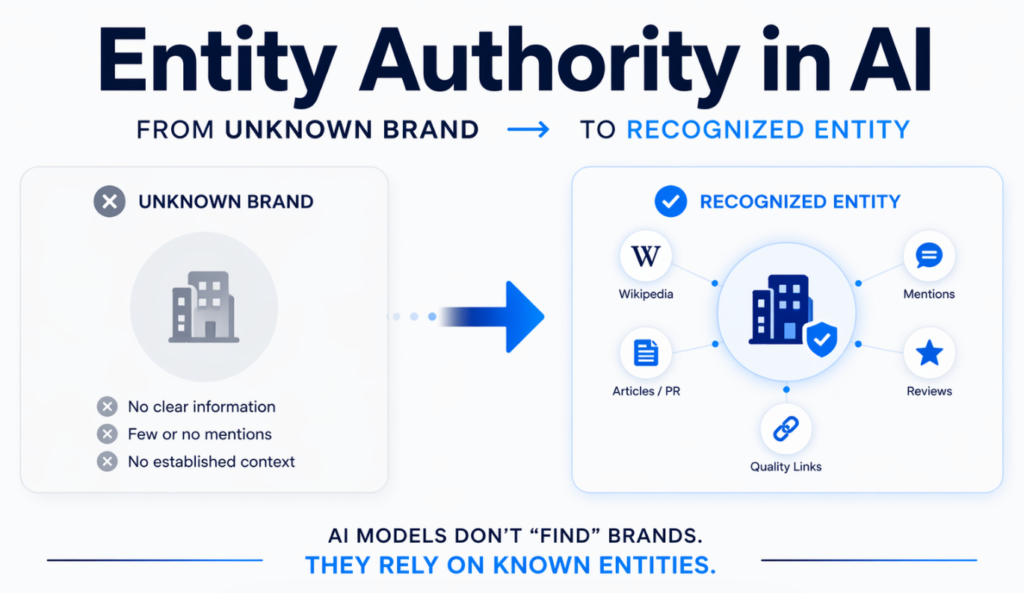
In AI environments, brands are treated as entities within a network of relationships. The stronger the entity signals surrounding a brand, the more likely it is to be recognized, categorized, and recommended by AI systems.
For a broader explanation of the strategic model, see The LLM Brand Positioning Framework.
What Is Entity Authority in AI
Entity authority describes the strength and credibility of a brand as an identifiable concept across the web.
Large language models learn about brands by analyzing massive corpora of text, structured data, documentation, and references across the internet. When a brand appears repeatedly in authoritative contexts, the model builds a stronger representation of that entity.
This representation influences whether the brand will appear in AI-generated answers.
If you want the definition layer of this concept, see What Is LLM Brand Positioning.
How AI Systems Recognize Brands as Entities
AI models do not discover brands the way humans do. They infer entity identity through patterns of language and relationships.
Three signals are particularly important:
- Consistent brand mentions across trusted sources
- Clear association with a specific product category
- Contextual relationships with other recognized entities
When these signals align, the model becomes confident that the brand is a meaningful entity within the domain.
Why Entity Authority Drives AI Recommendations
When a user asks an AI system for recommendations, the model must choose which brands belong in the answer.
Because the system cannot browse the internet in real time the way a human researcher would, it relies on its internal representation of entities and their relationships.
Brands with strong entity authority have a higher probability of inclusion.
This is why some companies appear repeatedly in prompts such as:
- Best AI marketing platforms
- Top sports data providers
- Recommended analytics tools
The model selects entities that it considers authoritative within that category.
The Role of Category Alignment
Entity authority alone is not enough. A brand must also be clearly associated with the correct category.
If a company describes itself inconsistently—using multiple product definitions or vague positioning—the model’s internal categorization becomes weaker.
Clear category alignment strengthens the probability that the brand will be selected when a relevant prompt appears.
This mechanism is part of what determines how AI recommends brands inside generated answers.
Building Entity Authority for AI Discovery
Strengthening entity authority requires more than traditional SEO tactics. The goal is to reinforce the brand’s presence as a recognized concept across multiple trusted environments.
Key actions include:
- Consistent brand references across authoritative publications
- Clear product category definitions
- Structured data that reinforces entity identity
- Association with recognized organizations, technologies, and topics
These signals collectively shape how language models understand and position a brand.
Entity Authority and AI Visibility
Entity authority directly influences AI visibility—the frequency with which a brand appears inside AI-generated answers.
Brands with weak entity signals may still rank in search engines, but they often struggle to appear in LLM responses.
Brands with strong entity authority, by contrast, tend to surface repeatedly across different prompts and models.
This consistency is a key driver of prompt market share.
The Strategic Implication
As AI systems become a primary discovery layer, entity authority will become one of the most important competitive advantages in digital markets.
Companies that actively reinforce their brand as a recognized entity across the web will increase their probability of appearing in AI-generated answers.
Companies that ignore this shift may remain visible in traditional search results while disappearing from the AI recommendation layer that increasingly guides buyer decisions.