
For two decades, digital marketing measured visibility through search rankings, impressions, and traffic.
But the rise of AI assistants is creating a new discovery environment where buyers ask questions and receive synthesized answers instead of browsing lists of links.
In this environment, a new metric is emerging: prompt market share.
Prompt market share measures how often a brand appears in AI-generated answers across relevant prompts. The companies that dominate AI answers gain disproportionate visibility before a buyer ever visits a website.
This shift represents a fundamental evolution in how digital visibility should be measured.
To understand the broader strategic model behind this change, see The LLM Brand Positioning Framework.
What Is Prompt Market Share
Prompt market share refers to the percentage of AI prompts in which a specific brand appears within generated answers.
Instead of measuring where a page ranks in search results, prompt market share measures how often a brand is recommended when users ask AI systems for information, comparisons, or product suggestions.
For example, if a brand appears in 30 out of 100 relevant AI prompts, its prompt market share would be 30%.
This metric reflects the brand’s presence within AI-generated discovery environments.
Why Prompt Market Share Matters
AI assistants are rapidly becoming a primary interface for information discovery.
When users ask questions such as:
“What are the best AI marketing platforms?”
the brands appearing in the generated answer immediately influence the buyer’s perception of the market.
If a brand consistently appears in those responses, it gains a strong advantage in the early stages of the decision-making process.
This is why prompt market share is becoming one of the most important indicators of AI visibility.
How AI Systems Determine Prompt Market Share
Prompt market share is not determined by a single ranking algorithm. Instead, it emerges from multiple signals that influence how AI models generate answers.
Key factors include:
- Entity authority of the brand
- Clear category association
- Semantic relationships with other entities
- Consistency of brand mentions across trusted sources
These signals influence how language models decide how AI recommends brands in generated responses.
The Relationship Between Prompt Market Share and Brand Positioning
Prompt market share is closely connected to how a brand is positioned within AI systems.
If a brand is strongly associated with a category and recognized as a credible entity, it becomes more likely to appear in relevant prompts.
This concept is explained in detail in LLM brand positioning.
Strong brand positioning increases the probability that a brand will surface repeatedly across AI-generated answers.
Measuring Prompt Market Share
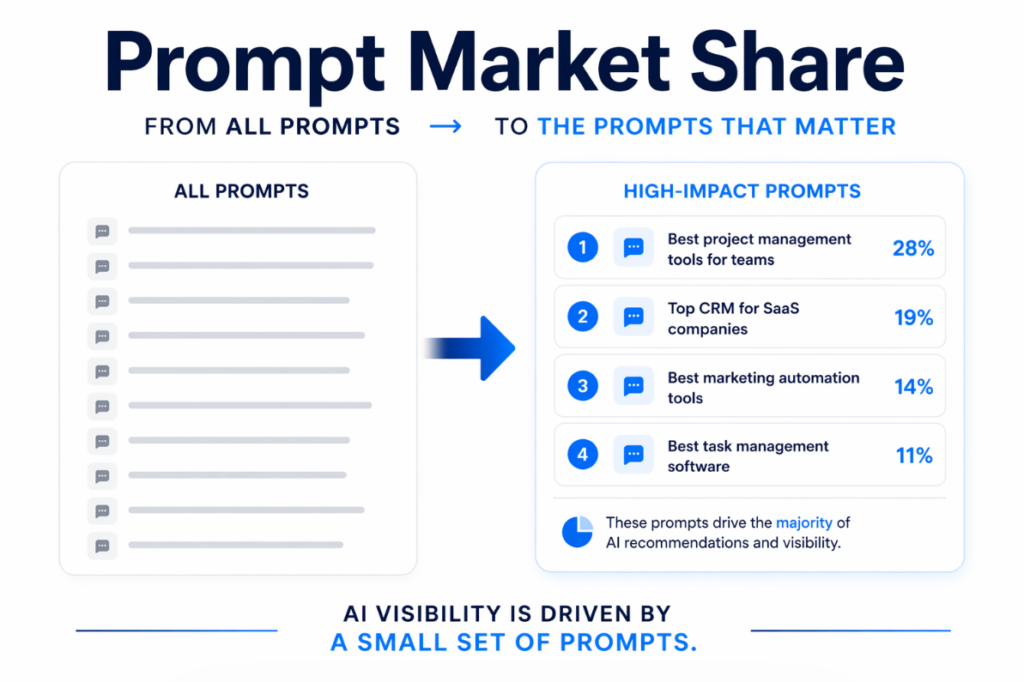
Organizations can estimate prompt market share by testing multiple high-intent prompts across different AI systems.
Examples of prompts include:
- Best platforms in a category
- Top tools for a specific use case
- Recommended vendors for a technology
- Alternatives to a known product
By tracking which brands appear across these prompts, companies can estimate their relative share of AI-generated visibility.
The Strategic Implications
As AI-driven discovery becomes more common, prompt market share may become as important as traditional search rankings.
Brands that dominate AI-generated answers gain early influence over buyer decisions.
Companies that fail to appear in those answers risk becoming invisible during the discovery phase of the buying journey.
Understanding and improving prompt market share will therefore become a central component of modern digital strategy.