For two decades, digital marketing operated under one fundamental assumption: humans discover products. Search engines, websites, landing pages, and dashboards were designed for human cognition—people browsed pages, compared options, and made purchasing decisions.
But discovery is undergoing a structural shift. Today, a growing share of product discovery happens through AI systems. Instead of browsing search results, users ask questions and receive synthesized answers from large language models.
This creates a new strategic challenge for companies: How does an AI system decide which brands to recommend? The answer leads to a new concept: LLM Brand Positioning.
What Is LLM Brand Positioning
LLM brand positioning describes how AI systems categorize, compare, and recommend brands when generating answers to user prompts. Instead of ranking web pages, language models evaluate entities. They build relationships between brands, categories, and attributes, then synthesize answers that reflect those relationships.
For a deeper definition, see What Is LLM Brand Positioning.
In AI-driven environments, visibility is no longer determined only by search rankings. It is determined by probabilistic inclusion inside AI-generated answers.
From Search Rankings to AI Recommendations
Traditional SEO focuses on ranking pages in search results. AI discovery environments operate differently: language models synthesize information from multiple sources and construct answers dynamically.
A user may ask: “What are the best AI brand visibility platforms?”
Instead of returning ten links, the system generates a structured answer recommending specific companies. This means brands now compete inside AI recommendation space, not just search results.
For more on how brands appear in AI-generated responses, see Brands in AI Answers.
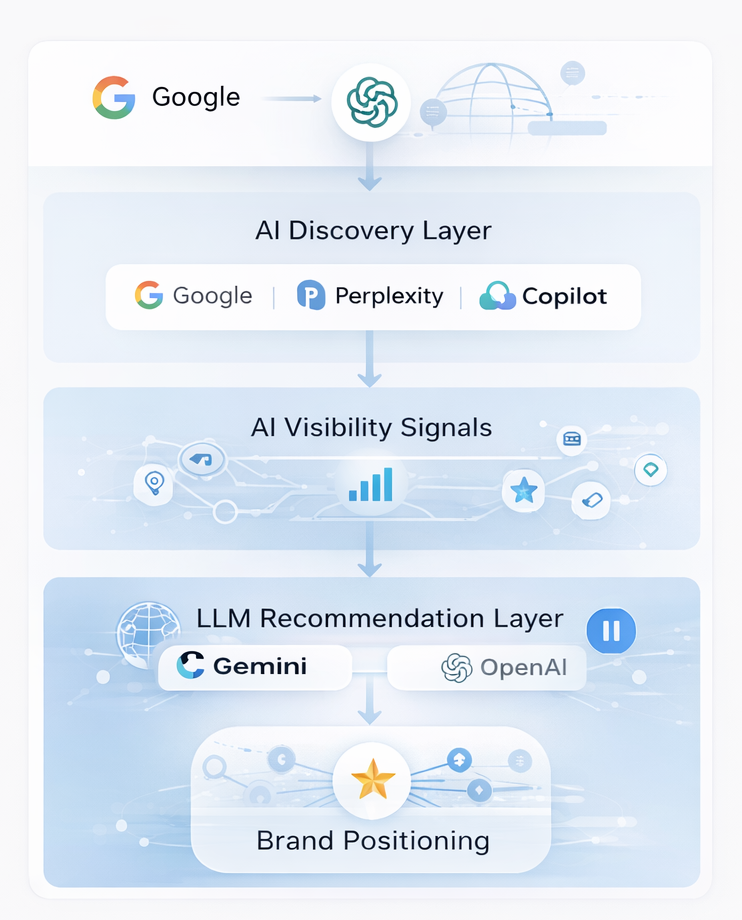
The Four Layers of LLM Brand Positioning
Brand positioning inside AI systems can be understood through four structural layers.
1. Entity Recognition
The model must first recognize that the brand exists. This requires strong entity signals across the web, including mentions, authoritative references, and consistent brand identity.
A detailed explanation appears in Entity Authority in AI.
2. Category Association
Once recognized, the model associates the brand with a category. These associations determine whether the brand is relevant to a specific prompt.
- AI brand visibility platforms
- Marketing analytics software
- Sports data providers
3. Comparative Inclusion
Next comes inclusion in comparative prompts such as:
- Best tools
- Top platforms
- Recommended solutions
These prompts define competitive landscapes inside AI systems. See How AI Recommends Brands.
4. Default Recommendation
The final stage occurs when the model consistently surfaces a brand across multiple prompts. At this point the brand becomes a default recommendation within its category.
Measuring AI Brand Positioning
Traditional metrics such as keyword rankings only partially reflect visibility in AI systems. New indicators are emerging, including:
- Prompt market share
- Recommendation frequency
- Probabilistic brand inclusion
For more on this concept, see Prompt Market Share.
Why This Framework Matters
The rise of AI-mediated discovery fundamentally changes the competitive landscape. Brands are no longer competing only for search rankings. They are competing for position inside AI-generated knowledge graphs.
Companies that understand this shift will focus on:
- Entity authority
- Semantic relationships
- Category dominance
Companies that ignore it may remain visible in search while becoming invisible inside AI systems.
The Future of Brand Discovery
As AI assistants and autonomous agents become more common, brand positioning inside AI systems will become a critical strategic discipline. In the near future, many purchasing journeys may begin not with a search engine but with a question asked to an AI assistant.
When that happens, the brands appearing in the answer will shape the market. Understanding LLM brand positioning is the first step toward preparing for that future.