
LLM brand positioning is the way large language models (LLMs) recognize your brand, associate it with a category, and decide whether to recommend it in AI-generated answers.
In classic marketing, positioning was shaped by what humans saw: ads, reviews, landing pages, and sales conversations. In AI-driven discovery, positioning is shaped by what models understand—how your brand appears across sources, how it connects to other entities, and how consistently it shows up in high-intent prompts.
This article defines LLM brand positioning, explains what drives it, and shows how it connects to AI visibility and recommendation behavior.
For the full strategic model, start here: The LLM Brand Positioning Framework.
Why “Brand Positioning” Changes in the LLM Era
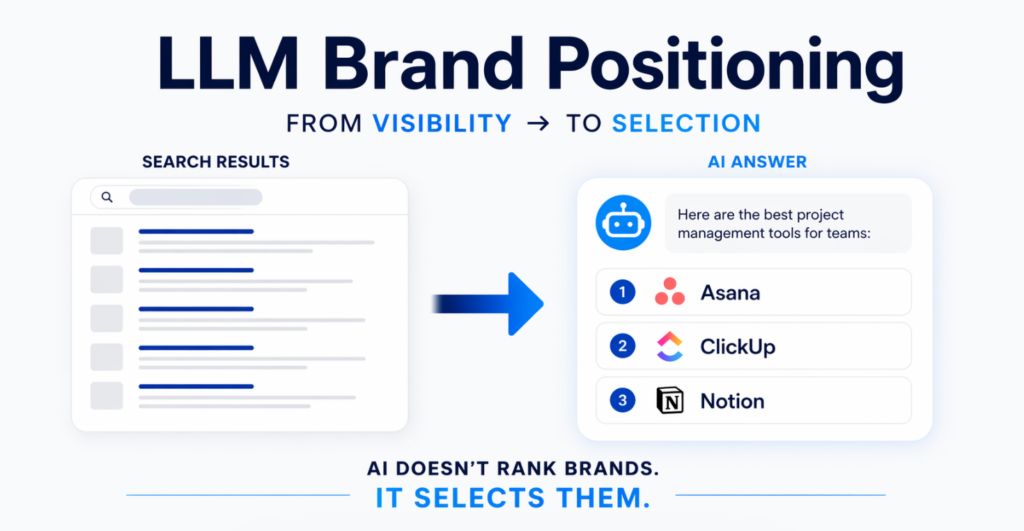
Search rankings are about pages. LLM answers are about entities.
When a user asks an AI system for “best platforms,” “top tools,” or “recommended solutions,” the model doesn’t simply list websites. It synthesizes a response by selecting brands that it believes belong in that category and match the intent.
That selection behavior is positioning—just not the human kind.
If you want the visibility angle, see: Brands in AI Answers.
Definition: LLM Brand Positioning
LLM brand positioning describes how an AI model:
- Recognizes your brand as a real entity
- Associates it with the right category and attributes
- Compares it against alternatives in “best/top” prompts
- Recommends it (or ignores it) in generated answers
In other words: it’s the model’s internal map of where your brand belongs—and whether it deserves inclusion.
The Practical Test
Here’s a simple way to think about it:
- If your brand is unknown to the model, it can’t be recommended.
- If your brand is mis-categorized, it will be recommended for the wrong prompts (or not at all).
- If your brand is weak in comparison, it may appear sometimes—but rarely in “best/top” lists.
- If your brand becomes a default example, it appears consistently across prompts and models.
What Drives LLM Brand Positioning
1. Entity Authority
Models need strong signals that your brand exists and matters. This is not only about links—it’s about consistent, high-quality, repeated references to the brand across credible sources.
Deep dive: Entity Authority in AI.
2. Category Clarity
The model must associate you with the right category. If your brand message is inconsistent—multiple categories, vague descriptors, unclear differentiation—the model’s associations weaken.
Great positioning is specific. It tells the model: “This brand belongs here, and it’s known for these attributes.”
3. Comparative Prompts
Most market-defining visibility comes from comparative prompts:
- Best / top / leading
- Alternatives to X
- Recommended for Y use case
These prompts are where models compare vendors and decide who “belongs” in the answer.
Related: How AI Recommends Brands.
4. Consistency Across Answers
Positioning isn’t just whether you appear once—it’s whether you appear reliably.
AI-driven discovery is probabilistic. The same prompt can produce different answers depending on phrasing, model, or context. Strong positioning reduces volatility and increases inclusion probability.
How LLM Brand Positioning Relates to AI Visibility
AI visibility is the measurable outcome: how often you appear, where, and for which prompts.
Brand positioning is the underlying cause: why the model believes you belong there.
If you want the measurement layer: Prompt Market Share.
What To Do Next
If you want a single starting point, read the pillar framework and then follow the supporting concepts:
- The LLM Brand Positioning Framework
- Entity Authority in AI
- How AI Recommends Brands
- Brands in AI Answers
LLM brand positioning is becoming a core competitive layer. The brands that models consistently recommend will shape markets—before a human ever visits a product page.