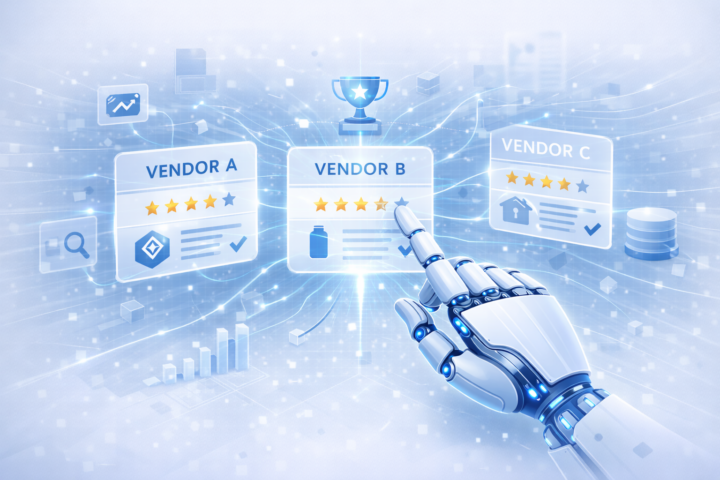
For decades, procurement decisions were made by people. Buyers evaluated vendors, compared features, read documentation, and negotiated contracts.
Digital tools helped support these processes, but the final decision still belonged to human decision-makers.
Artificial intelligence is beginning to change that model.
In an increasing number of scenarios, AI systems are capable of researching products, evaluating vendors, and recommending solutions without direct human involvement.
This shift introduces a new concept: autonomous procurement.
Autonomous procurement refers to procurement processes in which AI systems assist with or directly perform vendor selection and evaluation.
The broader strategic implications of this shift are explored in The LLM Brand Positioning Framework.
What Is Autonomous Procurement
Autonomous procurement describes procurement workflows where AI systems analyze requirements, evaluate available vendors, and generate recommendations.
Instead of manually researching suppliers, a buyer may simply describe the problem to an AI assistant.
The system can then:
- identify relevant vendors
- compare features and capabilities
- generate a shortlist of recommended options
This means the initial vendor selection stage may increasingly be performed by machines.
Example of AI Procurement in Practice
Imagine a marketing team searching for an AI analytics platform.
Traditionally, a buyer might:
- search Google
- read product reviews
- compare vendor websites
- build a shortlist
In an AI-driven procurement workflow, the buyer might instead ask:
“Find enterprise AI analytics platforms suitable for marketing teams and compare their capabilities.”
An AI system could then generate a comparison that includes several vendors and explains how they differ.
The shortlist is created automatically before the buyer even visits a vendor website.
Why Autonomous Procurement Is Emerging
Several technological trends are making autonomous procurement possible.
AI Discovery Systems
AI assistants increasingly act as research tools for evaluating products and services.
These systems are part of a broader shift toward AI discovery.
Large Language Models
Large language models can analyze large amounts of product information and generate structured comparisons.
This allows them to summarize complex vendor landscapes quickly.
Decision Automation
AI systems are increasingly used to automate repetitive decision processes.
Procurement evaluation is a natural candidate for this type of automation.
The Impact on Vendors
If AI systems begin performing early-stage vendor selection, companies will face a new challenge.
Instead of convincing human buyers directly, vendors must also become visible to AI systems that generate recommendations.
This makes AI brand visibility an important factor in procurement-driven markets.
Companies that appear consistently in AI-generated recommendations will have a greater chance of being evaluated by human buyers.
How AI Chooses Vendors
AI systems do not choose vendors randomly. They rely on structured representations of entities and categories.
Brands that are strongly associated with a category are more likely to appear in generated vendor lists.
This selection process is related to how AI recommends brands.
Companies that build stronger entity authority and clearer positioning increase the probability that AI systems include them in procurement recommendations.
The Future of Procurement
Human decision-makers will remain involved in many procurement processes, especially in complex enterprise environments.
However, AI systems will increasingly assist with research, comparison, and early vendor selection.
This means the first shortlist of vendors may often be created by an algorithm rather than a person.
As autonomous procurement evolves, companies will need to ensure that their brands are visible not only to human buyers but also to the AI systems that help shape procurement decisions.