Procurement decisions have traditionally been shaped by human judgment. Buyers evaluated vendors, compared features, read reviews, and built shortlists based on their understanding of the market.
Artificial intelligence is beginning to reshape that process.
Instead of manually comparing vendors, organizations increasingly rely on AI systems that analyze information, compare options, and generate recommendations.
These systems are often described as AI decision engines.
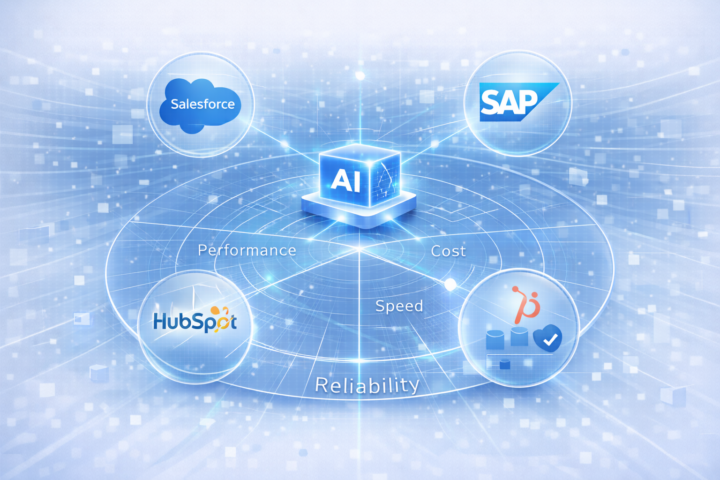
An AI decision engine evaluates available options within a category and produces a structured recommendation based on available information.
The strategic implications of this shift are part of the broader transformation described in The LLM Brand Positioning Framework.
What Are AI Decision Engines
AI decision engines are systems that analyze data and generate recommendations to support or automate decision-making processes.
In procurement contexts, these systems can evaluate vendors by analyzing product descriptions, documentation, reviews, and category knowledge.
Instead of simply listing companies, the system may generate a structured comparison that highlights differences between vendors.
This makes decision engines especially useful during early-stage research and vendor evaluation.
Example of an AI Decision Engine in Action
Imagine a company looking for an enterprise customer data platform.
Traditionally, a buyer might:
- search for vendors
- visit several websites
- compare features manually
- build a shortlist
With an AI decision engine, the process can begin with a single request:
“Compare the leading enterprise customer data platforms and explain how they differ.”
The AI system may generate an answer that includes:
- a shortlist of vendors
- a summary of their strengths
- a comparison of capabilities
The evaluation step happens automatically.
The Signals AI Uses to Evaluate Vendors
AI decision engines rely on several signals when comparing companies.
Entity Authority
Brands that appear frequently across credible sources develop stronger authority signals.
This makes them more likely to be included in vendor comparisons.
This concept is explained in Entity Authority in AI.
Category Relevance
AI systems must understand which vendors belong to a category.
Companies with clear positioning are easier for decision engines to evaluate.
This positioning layer is explored in LLM Brand Positioning.
Semantic Context
Large language models interpret information through networks of entities and topics.
Vendors that are consistently associated with relevant technologies and industry concepts are easier for the system to compare.
Why AI Decision Engines Change Vendor Competition
In traditional search environments, users compare multiple websites and sources.
With AI decision engines, the system often performs that comparison automatically.
This means vendors are increasingly evaluated inside the AI response itself.
If a company is not included in the generated comparison, it may never enter the buyer’s shortlist.
This dynamic is closely related to AI brand visibility.
The Role of AI Recommendation Systems
Decision engines often rely on recommendation mechanisms similar to those used by AI assistants.
These systems identify relevant vendors and assemble a list of recommended options.
The process is closely related to AI recommendation systems and to the way AI recommends brands.
The Future of AI Decision Engines
As AI systems become more integrated into enterprise workflows, decision engines will increasingly assist with vendor evaluation and procurement research.
Human buyers will still make final decisions in many cases, but the early stages of vendor discovery and comparison may be heavily influenced by AI-generated recommendations.
Organizations that understand how AI decision engines evaluate vendors will be better positioned to remain visible in AI-driven procurement environments.