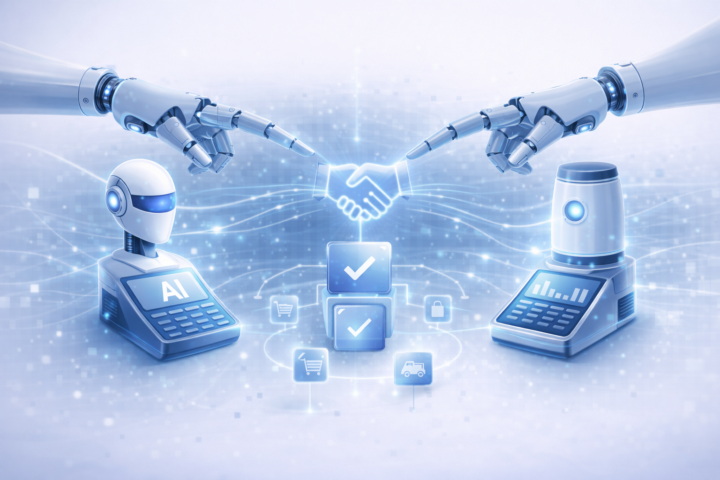
Commerce has historically been built around human decision makers. Buyers researched products, compared vendors, and negotiated purchases.
But advances in artificial intelligence are beginning to introduce a new model of economic activity: machine-to-machine commerce.
In this emerging environment, autonomous software agents can evaluate options, compare solutions, and recommend purchases with minimal human intervention.
Instead of humans navigating websites and product pages, AI systems may perform much of the discovery and evaluation process automatically.
This shift is closely connected to the rise of AI agents buying software and the growing importance of AI visibility in digital markets.
What Is Machine-to-Machine Commerce
Machine-to-machine commerce describes a purchasing environment where software systems interact with other software systems to evaluate vendors, negotiate options, and execute transactions.
In this model, AI agents act on behalf of organizations or users to analyze information and recommend decisions.
Instead of manually researching dozens of vendors, a company may instruct an AI system to identify the best solutions for a specific requirement.
The AI agent then gathers information, compares alternatives, and produces a recommendation.
Why AI Agents Are Becoming Buyers
AI agents are increasingly capable of performing tasks that previously required human analysis.
Modern systems can interpret natural language instructions, evaluate complex datasets, and generate structured comparisons between products.
This allows organizations to delegate large parts of the research and evaluation process to autonomous systems.
As a result, machine-to-machine commerce is becoming a realistic scenario for many industries.
How AI Agents Evaluate Vendors
When AI agents analyze vendors, they rely on structured knowledge about brands and categories.
These systems interpret companies as entities and evaluate them based on their authority, relevance, and relationship to the task.
This mechanism is similar to how AI recommends brands within generated answers.
Brands that have strong entity signals and clear category positioning are more likely to be selected by autonomous systems.
The Role of AI Visibility in Machine-to-Machine Commerce
For companies operating in AI-driven markets, visibility inside AI systems becomes critical.
If autonomous agents increasingly influence purchasing decisions, the brands recognized by those systems will shape the outcome of procurement processes.
This is where AI visibility plays a central role.
Brands that frequently appear across AI-generated answers gain higher probability of being evaluated by autonomous buyers.
Those that remain invisible may never enter the decision set.
This dynamic is closely related to prompt market share, which measures how often brands appear across relevant AI prompts.
The Strategic Implications for Businesses
Machine-to-machine commerce introduces a fundamental shift in how companies must approach digital strategy.
Instead of focusing only on persuading human visitors, organizations must ensure that their brand is recognizable and interpretable by AI systems.
This includes strengthening entity authority, clarifying category positioning, and reinforcing semantic relationships across the web.
These signals help autonomous systems understand where a brand belongs within a market.
The Future of Autonomous Commerce
While human decision makers will continue to play a role in procurement, AI agents are likely to influence increasing portions of the discovery and evaluation process.
As these systems become more capable, machine-to-machine commerce may become a common layer within digital markets.
Companies that prepare for this shift early will be better positioned to remain visible as autonomous agents begin to participate in purchasing decisions.
In the coming years, the brands recognized by AI systems may become the brands chosen by both machines and humans.