But something is changing – and it’s happening quietly.
More and more of the early buying process is no longer handled by people. It’s handled by AI.
Instead of opening 10 tabs and comparing vendors, someone might ask:
“What are the best AI visibility platforms for enterprise companies?”
And within seconds – they get an answer.
A structured one. With specific companies. Sometimes even with a recommendation.
At that moment, the “buyer journey” didn’t start on your website.
It started inside a prompt.
What Are AI Prompt Buyers?
AI prompt buyers are not traditional personas.
They’re not “Marketing Director Dan” or “Startup Founder Sarah.”
They’re the structured context that AI systems use to make decisions.
Think of it this way:
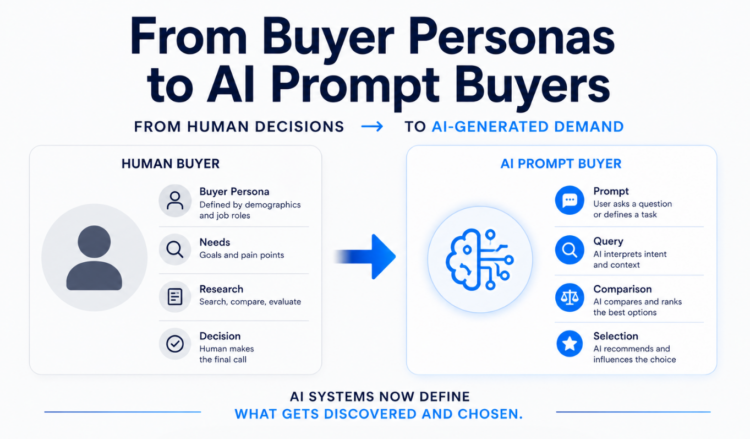
- A persona describes a person
- A prompt defines a decision
And AI systems operate on decisions.
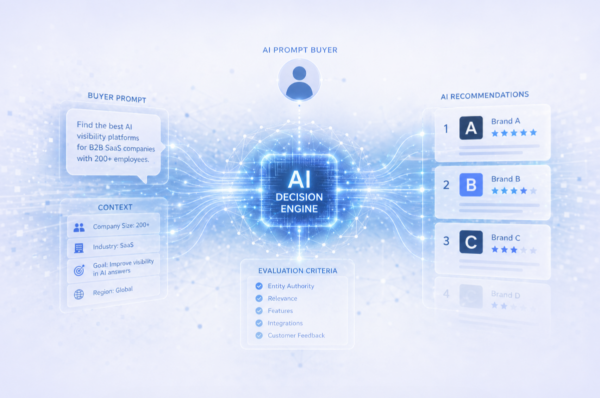
For example, instead of targeting a persona, the real “entry point” might look like this:
Find the best tools for improving brand visibility in AI answers for a B2B SaaS company with 200+ employees.This single prompt already contains:
- intent
- company size
- use case
- evaluation context
Which means the AI doesn’t need your persona.
It already has what it needs to decide.
This is exactly where new approaches around AI prompt buyers are starting to emerge – helping companies understand how they show up inside these AI-driven decisions.
From Personas to Prompts
The traditional flow was simple:
Persona → Messaging → Website → ConversionNow it looks more like this:
Prompt → AI Processing → Answer → Brand SelectionNo browsing. No comparison tables. No long consideration phase.
Just a question – and an answer.
And if your brand isn’t in that answer, you’re not really in the game.
The Rise of Buyer Prompt Generators
We’re starting to see tools evolve in this direction.
Some are still rooted in the old world, while others are getting closer to how AI actually works.
1. Classic Persona Builders
Tools like HubSpot Make My Persona or FounderPal help you build detailed profiles of your target audience.
They’re great for understanding messaging – but they were designed for humans, not machines.
2. Prompt-Based Systems
Tools like AIPRM or PromptBase move one step closer.
They help you create structured prompts and simulate scenarios directly inside AI tools.
This is where things start to shift from describing buyers… to simulating decisions.
3. Performance-Oriented Tools
Platforms like Triple Whale connect audience definition with real performance data.
They hint at something bigger:
Understanding not just who your audience is – but what actually drives outcomes.
How AI Actually Makes Buying Decisions
AI doesn’t “think” like a human buyer.
It follows a structured process:
- It receives a prompt
- It extracts intent
- It applies constraints
- It identifies relevant companies
- It compares and generates an answer
For example:
“Compare the top AI SEO tools for enterprise companies and recommend one.”
The output might be a shortlist of 3–5 companies.
And that shortlist is incredibly powerful.
Because most users won’t go much further than that.
A Simple Framework to Understand It
If you break it down, most AI-driven buying decisions follow a similar structure:
- Intent – what is the user trying to achieve?
- Constraints – company size, region, budget
- Evaluation – what criteria matter?
- Sources – what information is used?
- Output – which brands are selected?
Another quick example:
Best cybersecurity platforms for fintech startups in EuropeEven without a persona, the AI already understands the context.
And it will generate a list accordingly.
The New Competitive Layer
Most companies still compete on:
- SEO rankings
- content
- paid ads
But there’s a new layer forming underneath:
Competition inside AI-generated answers.
It’s not about being #1 in Google.
It’s about being included in the answer at all.
Because when AI gives a shortlist, it effectively defines the market.
What This Means Going Forward
Buyer personas aren’t going away.
But they’re no longer enough on their own.
The real shift is this:
The interface between buyers and companies is moving from websites to prompts.
And that changes how discovery works.
It changes how comparison works.
And ultimately – it changes how decisions are made.
Final Thought
In the past, companies competed to influence people.
Now, they also need to be understood by machines.
Because in more and more cases, the machine is the one making the first recommendation.
And if you’re not part of that recommendation, you’re not part of the decision.